Deducting the cost of business assets: depreciation

Your business costs can usually be deducted immediately from your profits. But if you buy a business asset, you may not deduct the costs from your profit in one go. As a business asset usually has a useful life of several years, you spread the cost over those years. This is called depreciation, or afschrijven in Dutch. Find out how it works.
What are business assets?
Business assets are items that you use to run your company, and that are not meant for sale. You need to invest in business assets to make your products or provide your services. Examples of business assets are:
- Buildings, machines, and vehicles
- Inventory, such as computers, furniture, equipment, and tools
- Goodwill, permits, and licences
What is depreciation?
Usually, you can deduct your business costs directly from your profit. However, if you purchase a business asset costing €450 or more, you cannot deduct the full cost in the year of purchase. Instead, you must depreciate the asset. This means spreading the cost over the years during which you use the asset. Each year, you deduct part of the cost in your income tax return or corporate tax return.
If you purchase a business asset for less than €450, you may deduct the cost from your profit immediately. You do not need to depreciate the asset.
Understanding financial terms
Good to know: In English, 'depreciation' is used for physical assets. While the term 'amortisation' may be used for non-physical assets, such as goodwill. By comparison, in Dutch, the word afschrijven is used for both of these situations. That is why in this article, we use depreciation broadly to cover both meanings.
Are you less familiar with financial and tax words in English? Check our glossary to see English and Dutch terms and what they mean.
How much can you depreciate every year?
The maximum annual depreciation is usually calculated as a percentage of the asset’s purchase price:
- Most investments have a maximum depreciation rate of 20%. So the depreciation of the asset takes a minimum of 5 years.
- Goodwill can be written off by a maximum of 10% per year.
Random depreciation for starters or sustainable assets
Sometimes you can depreciate a business asset faster than usual. For example, have you just started your business? Or have you invested in an environmentally friendly business asset? Then you may be able to take advantage of random depreciation (willekeurige afschrijving). This means that you can decide for yourself how long it takes to depreciate an asset. Find out more about random depreciation (in Dutch) on the Netherlands Tax Administration's website.
How do you calculate depreciation?
There are different ways to calculate depreciation. Ask your accountant or tax consultant which method offers the maximum tax advantage for your company.
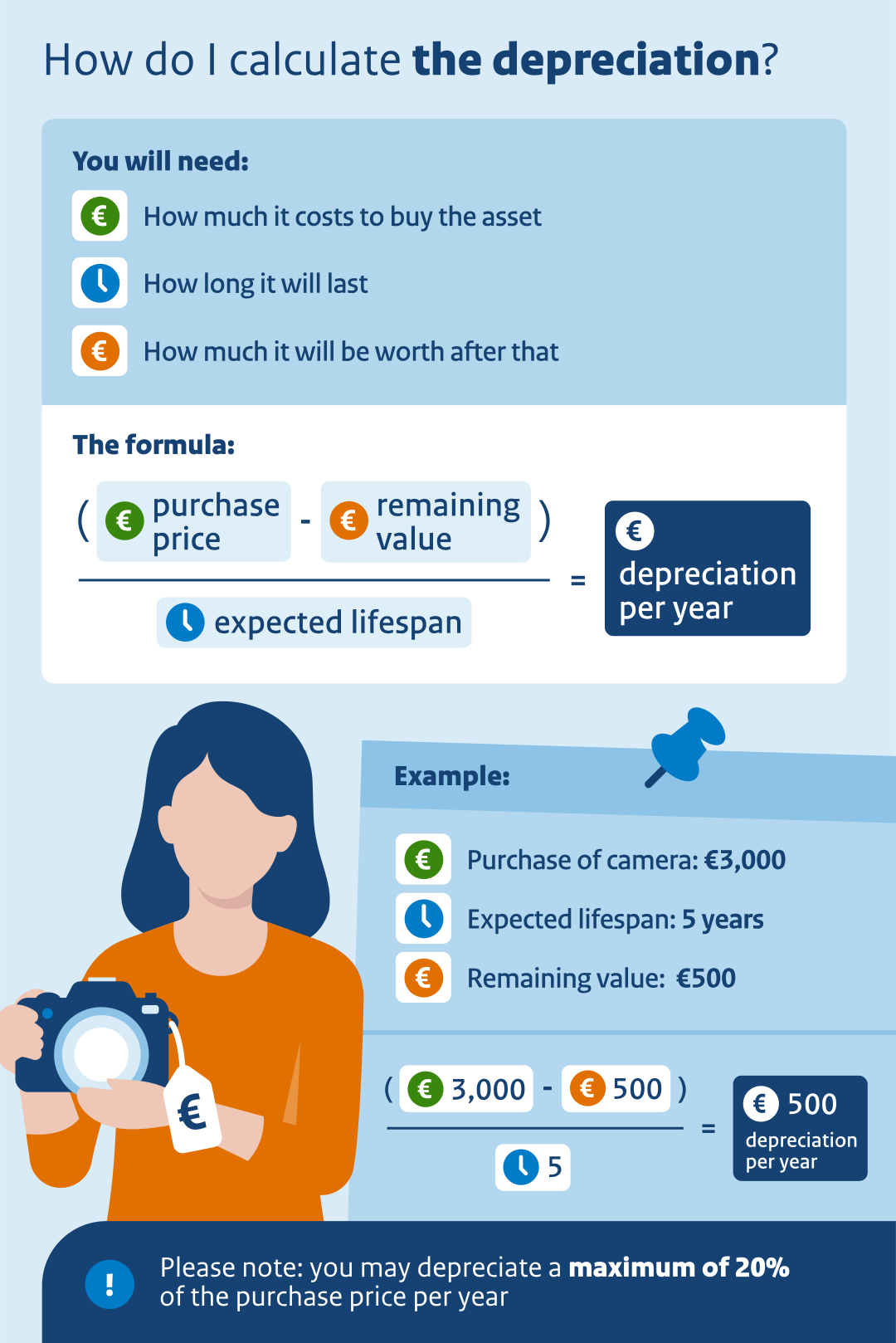
How do I calculate the depreciation amount?
You will need:
- The purchase price (acquisition cost)
- How long it will last (expected useful life)
- How much it will be worth afterwards (residual value)
The formula:
Subtract the residual value from the purchase price. Then divide this amount by the expected lifespan. The result is the annual depreciation.
Example:
Camera purchase: €3,000 Expected lifespan: 5 years Remaining value: €500 Calculation: €3,000 purchase price minus €500 residual value = €2,500. €2,500 divided by 5 is €500 depreciation per year.
Please note: you may depreciate a maximum of 20% of the purchase price per year.
The method used most often is linear calculation. When you use this method, every year you write off a fixed amount of the difference between the purchase cost and the remaining value of the asset at the end of its expected life.
The formula for linear calculation is:
- depreciation per year = (purchase cost – remaining value) / expected duration of use
Are you using the asset for the first time later in the year? For example, from 1 October. You may only depreciate in that year for 3 months: October, November, and December. Then you use this formula to calcuate depreciation for part of the year:
- depreciation per year × number of months ÷ 12
This is the amount you paid for your asset. You may also include notary and installation costs as well. You deduct any discounts or subsidies, even if you receive them at a later date. It does not matter whether the asset is new or used.
For the expected lifetime, you normally take the number of years until the asset no longer works. This is also called the technical lifetime. You may estimate how long it will be until the asset stops working.
But some assets are obsolete before that, even if they still work. They are obsolete compared to what is currently on sale in shops. For example, a mobile phone. Then you may choose to count the number of years until the asset will be obsolete. This is the economic lifetime. You may estimate how many years it will take until the asset becomes obsolete.
Does the asset break down sooner than you had estimated? Then you must write off the remaining value that has not yet been depreciated. This is the book loss. If you have also incurred repair costs, these will not be included in the depreciation. These are ordinary business expenses that you can deduct from your profit.
Or do you discover that the asset will become obsolete sooner than you estimated? Then adjust the value to write off in the coming years. Again, make sure the new annual amount does not exceed 20% of the purchase cost. You do not need to adjust the previous instalments.
Expected service life of used equipment
Have you bought a used asset? That usually has a shorter lifespan. But even then, you are only allowed to write off a maximum of 20% of the purchase cost per year. Even though it will possibly stop working after just 2 years.
The remaining value is the value your asset is likely to have left when you no longer use it for your business. You may estimate this value yourself. For example, by considering what it would be worth if you were to sell it. The asset may have no remaining value after its useful life. In that case the remaining value is €0. Do you sell the asset after its lifetime and does it fetch more or less than the value you estimated? Then you report the difference as profit or loss in your income tax return.
Are you unable to estimate the remaining value of the asset yourself? Check with a manufacturer of the asset.
Cost of purchase
You buy a laptop for €2,200. This is the purchase cost.
Expected duration of use
In approximately 3 years, your laptop will be out of date. The expected lifespan of your laptop is therefore 3 years.
Remaining value
A 3-year-old laptop is out of date. You estimate the remaining value of your laptop to be €100.
Maximum depreciation
You are allowed to write off a maximum of 20% of the purchase cost per year. For your laptop, that is:
- 20 / 100 × 2,200 = €440
Depreciation calculation
- (€2,200 - €100) / 3 = €700 per year
However, in this case there is a maximum depreciation limit of €440. So that will be the annual amount that can be depreciated.
Book loss
After 3 years, the laptop has a book value of €100. If you sell the laptop at that point for €75, you should declare a book loss of €25 on your tax return. If you sell the laptop for €225, you should declare a book profit of €125.
Calculate depreciation for only part of the year
Do you buy or start using the laptop on 1 October? In that year, you may only depreciate (3 / 12 * 440) = €110.
You can find more information on how to calculate the depreciation of your assets on the Tax Administration website (in Dutch).