Business Survey Netherlands (COEN)


Every quarter year, the Conjunctuurenquête Nederland questions entrepreneurs on topics that concern them. Topics such as turnover developments, profitability, investments, and staff. Included are questions about experiences in the past quarter and expectations for the current quarter. The business confidence survey combines various of these topics to identify an overall sentiment. It is available for the whole of the Netherlands, all business sectors, regions, and company sizes.
Business survey - 4th quarter of 2026
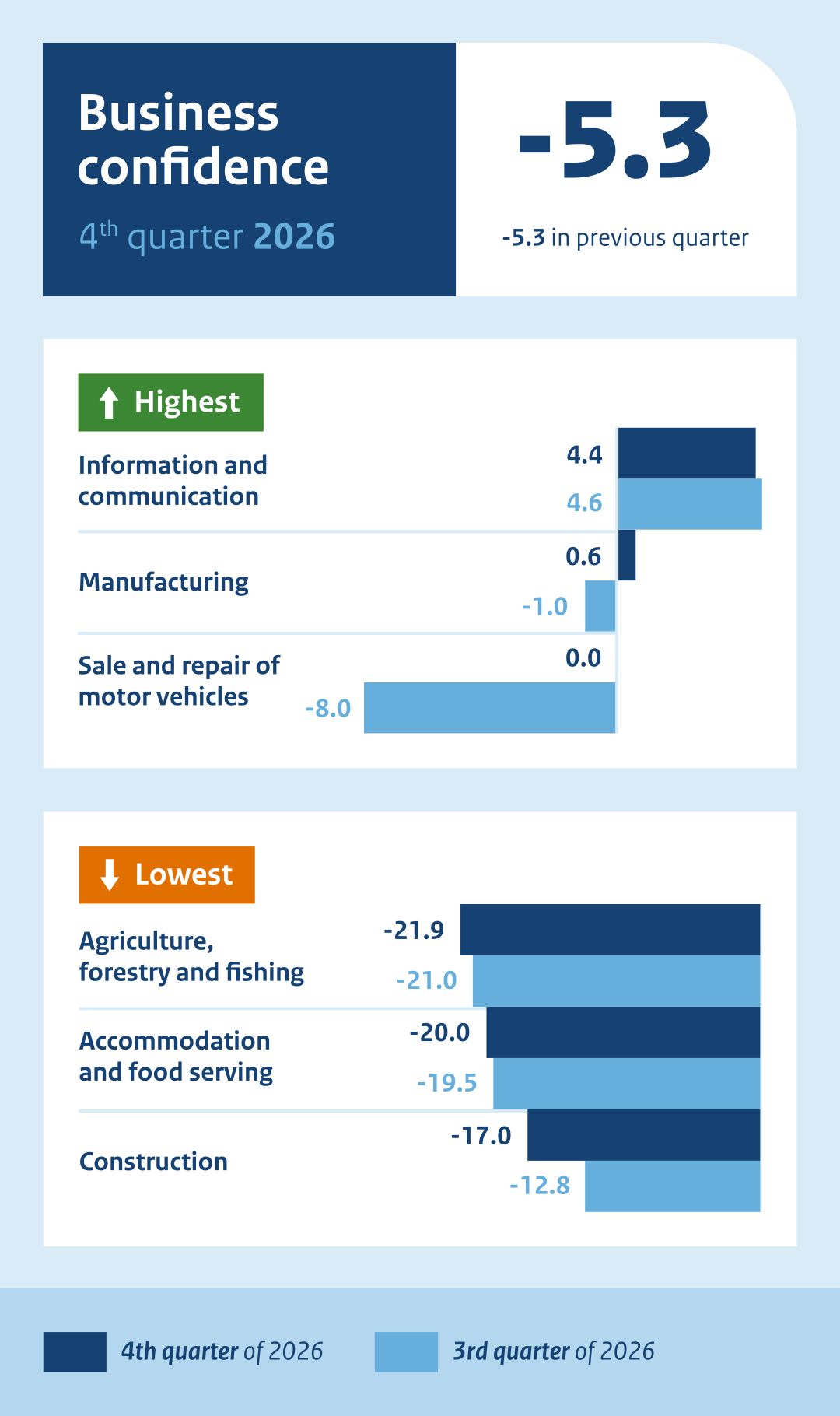
Business confidence has now been negative for 5 straight years and stands at -5.3 in the 4th quarter of 2026. That makes this number is the same as that of the previous quarter, when business confidence rose sharply following a sharp fall in the 2nd quarter of 2026. Business confidence is below the average (3.9) for the series since 2012. Since the end of 2022, business owners have been less negative about their expectations for the economic climate than about its actual trend. This pattern was interrupted only once, in the 2nd quarter of 2025. The gap between the expectations (-4.0) and the trend (-6.6) for the economic climate has narrowed this quarter compared with the 3rd quarter of 2026.
Business confidence
The overall figure for business confidence has remained unchanged from the previous quarter and is still negative. Business confidence is positive in the information and communication sector. In manufacturing, the figure shifted from negative to slightly positive. In the sales and repair of motor vehicles, business confidence improved from -8.0 to 0.0. As in the previous quarter, agriculture, forestry, and fisheries remain the most negative sector. Business confidence fell slightly from -21.0 to -21.9. Business confidence is also relatively strongly negative in the accommodation and food serving sector and construction sector.
The overall figure for business confidence has remained unchanged from the previous quarter and is still negative. Business confidence is positive in the information and communication sector. In manufacturing, the figure shifted from negative to slightly positive. In the sales and repair of motor vehicles, business confidence improved from -8.0 to 0.0.
As in the previous quarter, agriculture, forestry, and fisheries remain the most negative sector. Business confidence fell slightly from -21.0 to -21.9. Business confidence is also relatively strongly negative in the accommodation and food serving sector and construction sector.
Expectations
Across all 6 areas, more business owners expect an improvement than a deterioration; so, on balance, the mood here is positive. The balance for expected sales prices is the highest at nearly 21% on balance and has also risen the most; last year, this stood at just over 16%. Entrepreneurs are also positive about turnover in the coming 3 months, and the balance is higher than that for expected profitability. Expectations regarding investments have become slightly more positive.
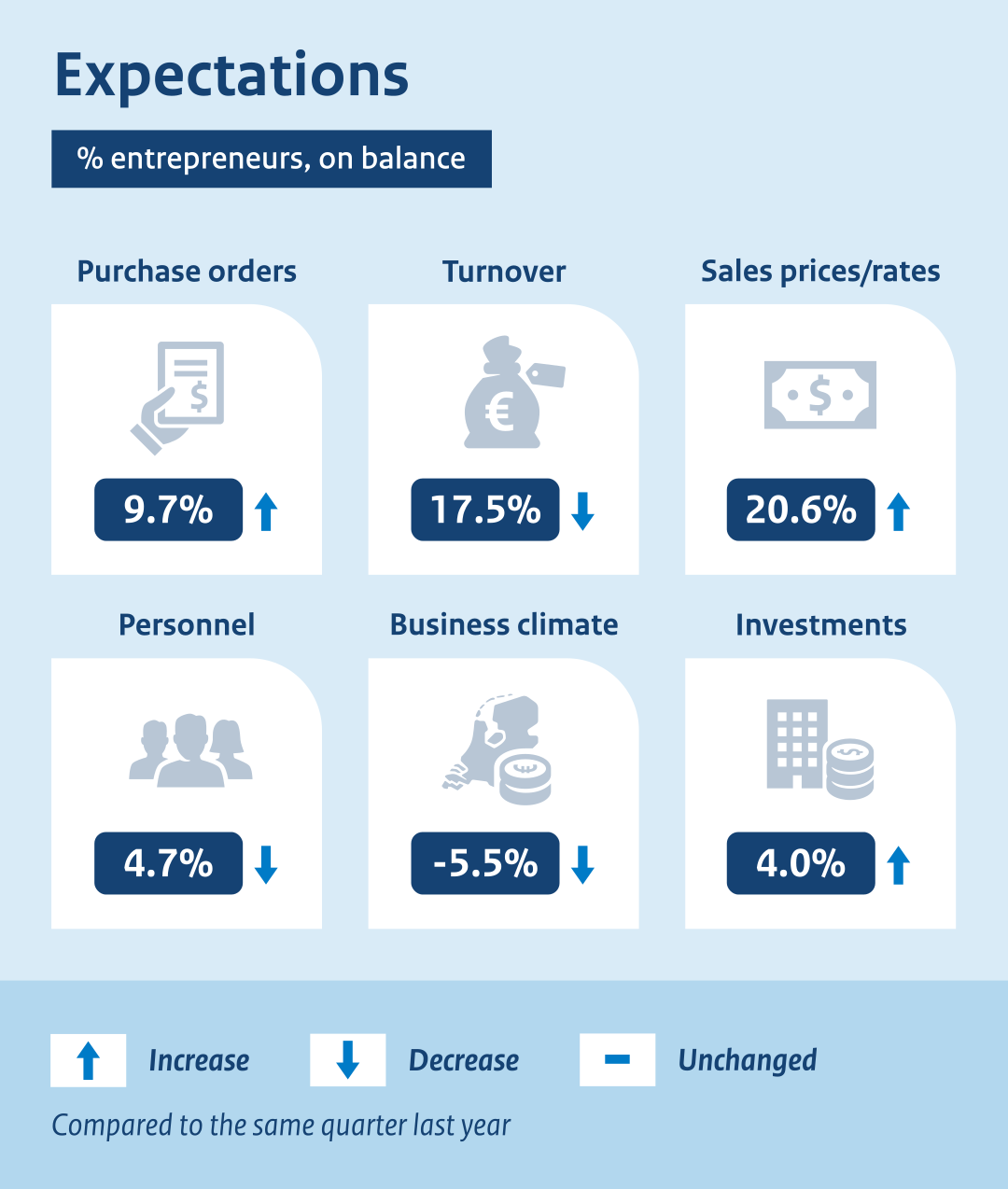
Across all 6 areas, more business owners expect an improvement than a deterioration; so, on balance, the mood here is positive. The balance for expected sales prices is the highest at nearly 21% on balance and has also risen the most; last year, this stood at just over 16%. Entrepreneurs are also positive about turnover in the coming 3 months, and the balance is higher than that for expected profitability. Expectations regarding investments have become slightly more positive.
Obstacles
Since the 3rd quarter of 2021, labour shortages have consistently been the most often cited obstacle by business owners. Following the COVID-19 crisis, this rose to over 49% in the third quarter of 2022. It then fell slowly, reaching almost 32% in the 4th quarter of 2026. This means the share has stayed almost the same compared with the previous quarter (33%). Almost a third of entrepreneurs stated they did not face any obstacles, which is almost the same as the share who faced a labour shortage.
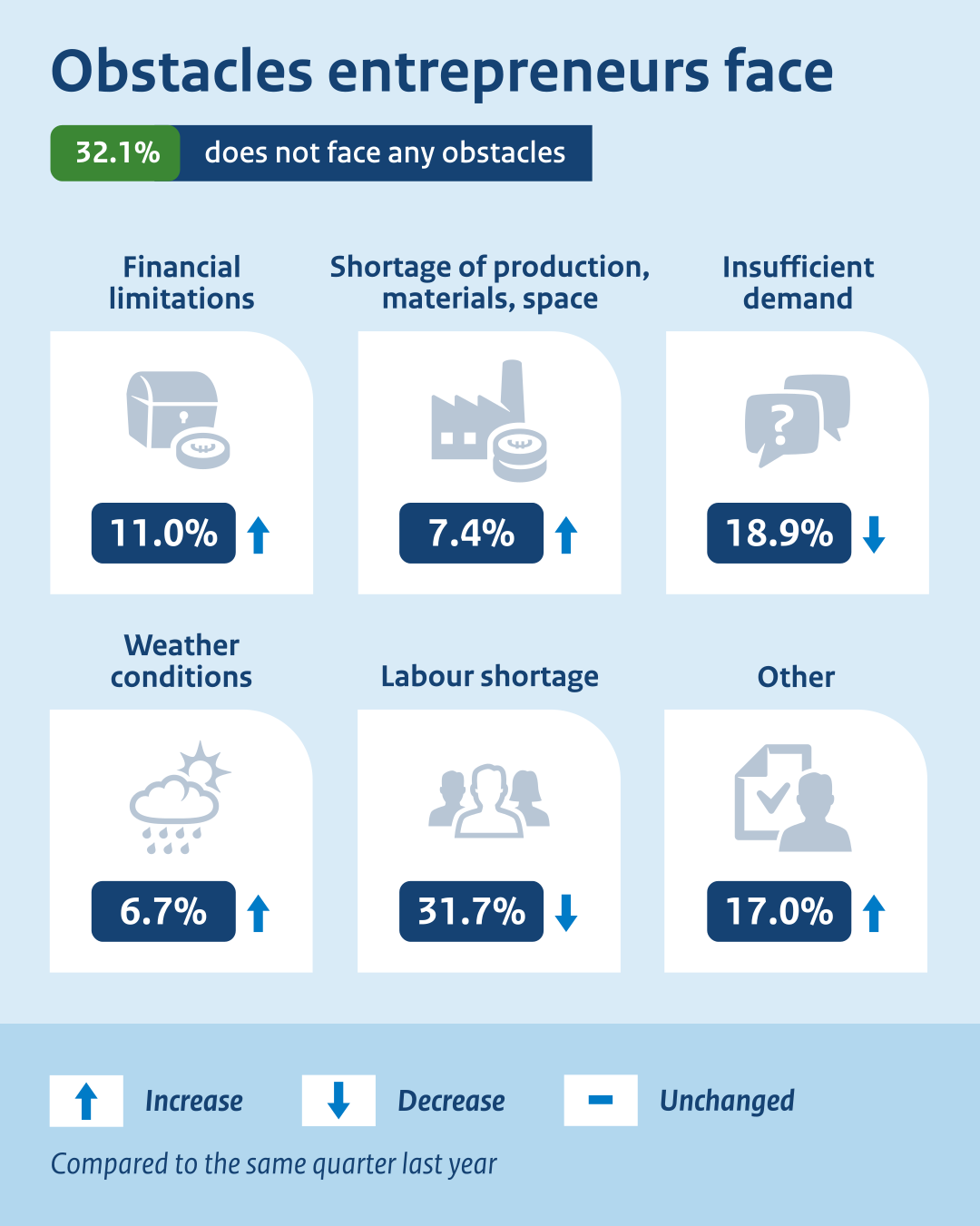
Since the 3rd quarter of 2021, labour shortages have consistently been the most often cited obstacle by business owners. Following the COVID-19 crisis, this rose to over 49% in the third quarter of 2022. It then fell slowly, reaching almost 32% in the 4th quarter of 2026. This means the share has stayed almost the same compared with the previous quarter (33%). Almost a third of entrepreneurs stated they did not face any obstacles, which is almost the same as the share who faced a labour shortage.
Expectations for 2027
For next year, more business owners expect an increase in their turnover than those expecting a decrease. The net balance is positive at 23.8%. Similarly, regarding personnel numbers, more business owners expect an increase in the coming year than a decrease. However, at just over 8.6%, the net balance is less positive than for expected turnover. On balance, 5.2% of entrepreneurs expect to invest more next year compared with this year. In most business sectors, entrepreneurs are slightly more positive about investment prospects for the coming year than they were a year ago. For next year, more entrepreneurs expect an increase in their turnover than expect a decrease. The balance is positive at 24%.
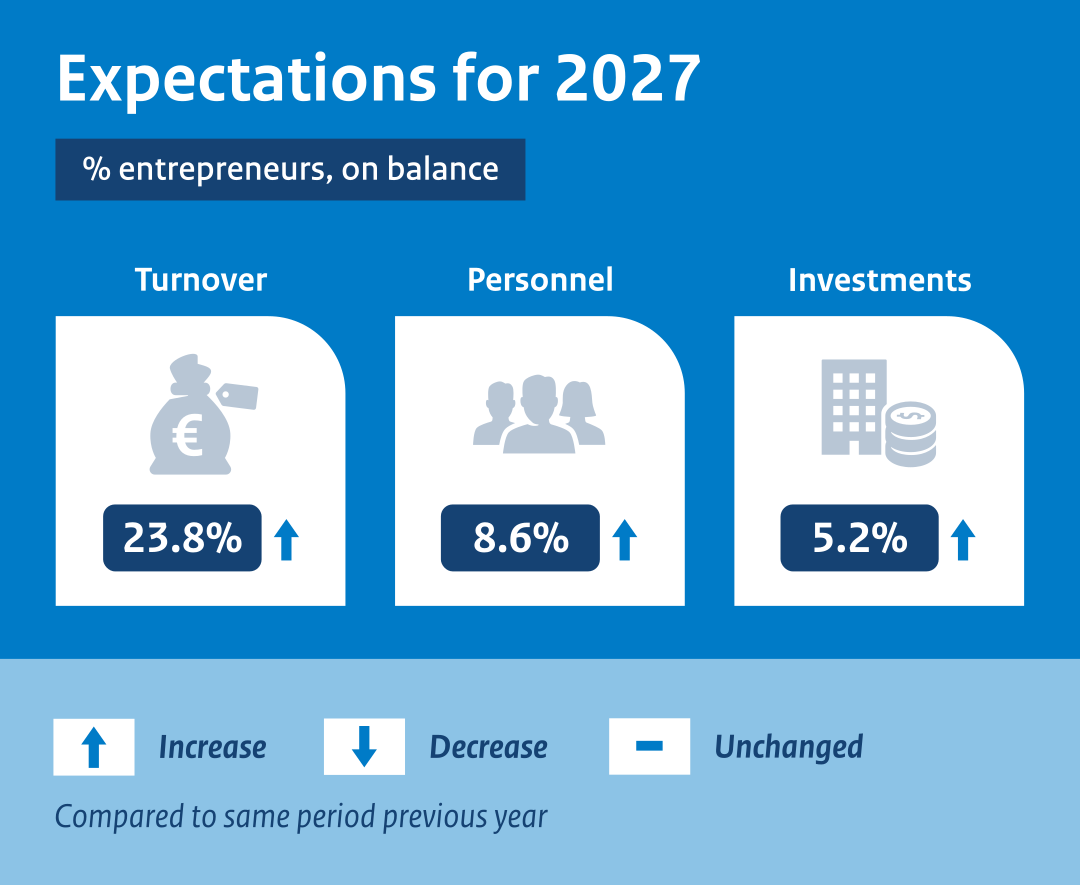
For next year, more business owners expect an increase in their turnover than those expecting a decrease. The net balance is positive at 23.8%. Similarly, regarding personnel numbers, more business owners expect an increase in the coming year than a decrease. However, at just over 8.6%, the net balance is less positive than for expected turnover. On balance, 5.2% of entrepreneurs expect to invest more next year compared with this year. In most business sectors, entrepreneurs are slightly more positive about investment prospects for the coming year than they were a year ago. For next year, more entrepreneurs expect an increase in their turnover than expect a decrease. The balance is positive at 24%.
View the full report
View the report containing a detailed description of the results (in Dutch).