How to make your business operations sustainable

With sustainable business operations, you can save money. For example, by using renewable energy instead of gas or oil. You will help reduce CO2 emissions that way. A sustainable image can also contribute to the success of your business.
What is sustainable entrepreneurship?
Sustainable entrepreneurship is about the balance between the three P’s: people, planet, profit. This means that you take into account the effects on your employees, the environment and society of the way you run your business. It is part of your responsible business conduct (RBC).
Determine how you want and need to apply sustainable measures
Think about which sustainable issues are important to you:
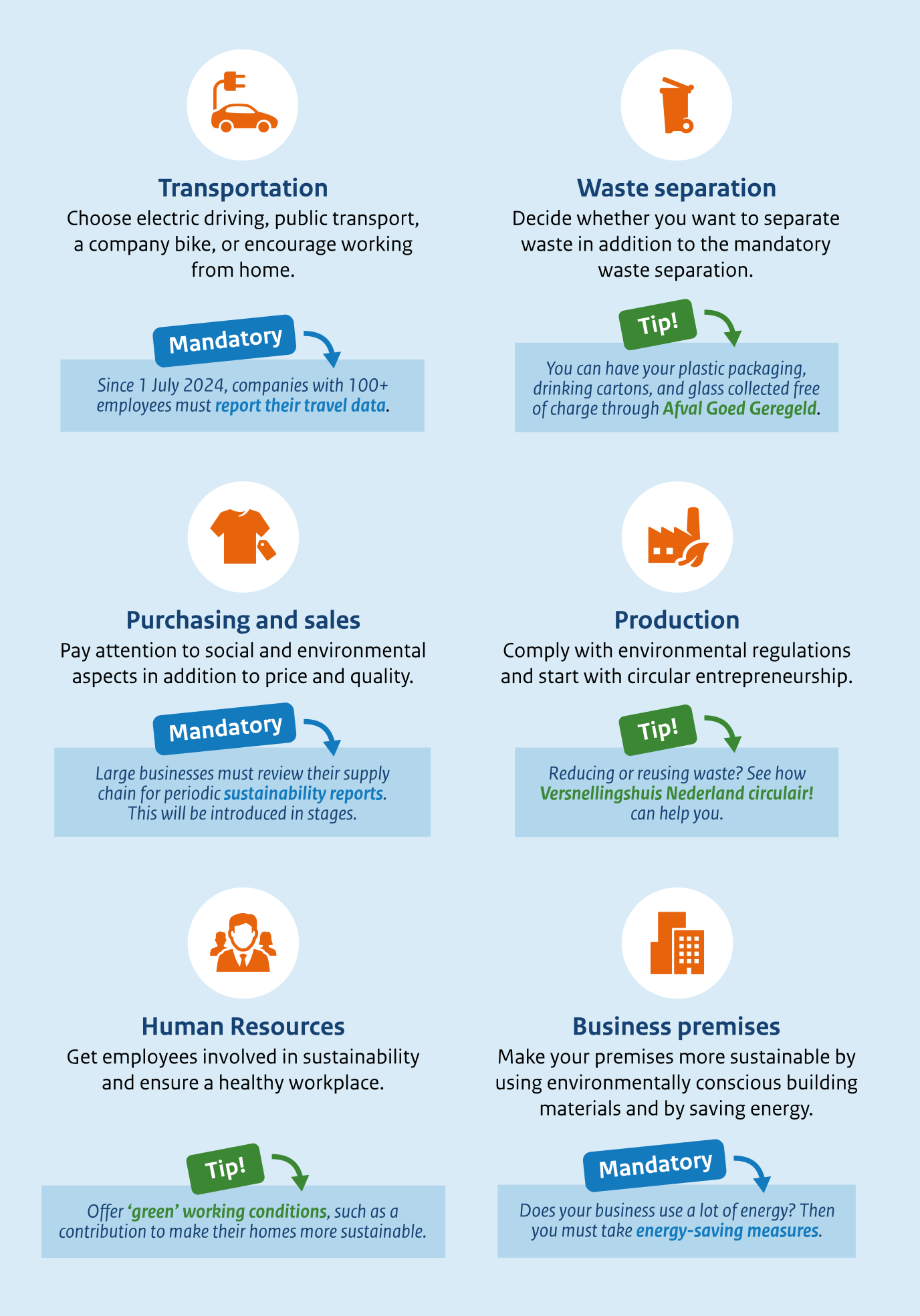
1. Transportation Choose electric driving, public transport, a company bike, or encourage working from home.
Mandatory: Since 1 July 2024, companies with 100+ employees must report their travel data.
2. Waste separation Decide whether you want to separate waste in addition to the mandatory waste separation.
Tip! You can have your plastic packaging, drinking cartons, and glass collected free of charge through Afval Goed Geregeld.
3. Purchasing and sales Pay attention to social and environmental aspects in addition to price and quality.
Mandatory: Large businesses must review their supply chain for periodic sustainability reports. This will be introduced in stages.
4. Production Comply with environmental regulations and start with circular entrepreneurship. Tip! Reducing or reusing waste? See how Versnellingshuis Nederland circulair! can help you.
5. Human Resources Get employees involved in sustainability and ensure a healthy workplace. Tip! Offer ‘green’ working conditions, such as a contribution to make their homes more sustainable.
6. Business premises Make your premises more sustainable by using environmentally conscious building materials and by saving energy.
Mandatory: Does your business use a lot of energy? Then you must take energy-saving measures.
Sustainable transport helps you reduce your CO2 emissions. Think electric driving, a company bicycle, or travelling by public transport. Or reduce your employees' commuting and business travel by encouraging working from home.
Travel reporting for 100 or more employees
Does your company have 100 or more employees? If so, you must report each year to Enterprise Agency Netherlands (RVO, in Dutch) on your employees' business and commuting travel. This includes, for example, the number of kilometres travelled, broken down by type of transport and fuel. You do not have to report CO2 emissions. Read more about the reporting obligation for work-related passenger mobility.
No more kilometre registration for medium-sized businesses
Do you employ more than 100 but fewer than 250 employees? In future you will no longer have to report on your employees' business or commuting trips. Kilometre registration for SME businesses will be abolished. It is not known when this changes will take effect.
Your are required to separate your company waste. Use the Company waste separation tool to find out to what waste this applies. Then decide whether you want to separate additional waste or reduce your waste. For example, to save costs or because you want to contribute to a better environment.
Free collection of packaging waste
You can have your plastic packaging, drinking cartons and glass collected free of charge through Afval Goed Geregeld (waste well arranged, in Dutch). Do you want to take part? Fill in your details on the form on the Afval Goed Geregeld website.
Processing waste more expensive in 2027
Do you bring industrial waste to an incineration plant? This will become more expensive from 1 January 2027. Waste incineration plants will pay higher taxes. The businesses bringing the waste will contribute to these costs. Read about the increase in charges for processing waste.
When you practice sustainable purchasing, you pay attention to social and environmental aspects in addition to price and quality. You know where products you buy come from, under what circumstances they were produced, and what the environmental impact of the production process and prooduction chain is.
Sustainability report CSRD
Large European businesses must provide insight into the impact of their operations and produce a sustainability report. This is set out in the Corporate Sustainability Reporting Directive (CSRD), a European directive. The directive will apply from 2027 to businesses with more than 1,000 employees and a net turnover of more than €450 million.
Do you work with these businesses? If so, you may be asked to share information about the sustainability of your products, services and business operations.
For production, you need to comply with environmental regulations. In addition, you could find a smarter way to use raw materials through circular entrepreneurship. In a circular economy, waste does not exist and we use products and raw materials again and again. Waste is the new raw material. For example, do you have ideas for reducing or reusing waste? Then you can get help from Versnellingshuis Nederland circulair! (Acceleration House Netherlands circular!, in Dutch).
New rules for repairing products
Do you make or sell electronic products such as washing machines, laptops, or mobile phones? From 31 July 2026, new rules will apply to the right to repair these products. It will be easier and cheaper for your customers to have them repaired instead of replaced. This may result in less waste.
Many employees find it important to work for a business that contributes to the environment and society. Make sure your employees know what your company’s sustainability goals are. They help with compliance and can point it out if something goes wrong. For example, child labour in the production chain.
A sustainable personnel policy includes good working conditions and the prevention of absenteeism. Or a healthy workplace. For example, offer sports opportunities and fruit. Or you have ‘green’ working conditions and help your workmates by contributing to make their homes more sustainable.
You can make your premises more sustainable by using environmentally conscious building materials and saving energy. Does your business use more than 50,000 kWh of electricity or 25,000 m³ of natural gas per year? Then you are obliged to take energy-saving measures. You must also report on this this to the Netherlands Enterprise Agency (RVO).
Building automation and control system (GACS) mandatory in 2026
Do you have commercial premises such as an office or warehouse? Since 1 January 2026, buildings with heating or air-conditioning systems with a capacity of more than 290 kW must have a building automation and control system (gebouwautomatiserings- en controlesysteem, GACS). This smart system helps you save energy and make your building more efficient. From 2030, the GACS requirement will also apply to systems above 70 kW.
Read more about what this means for you as a building owner (in Dutch).
Choose sustainable energy
With sustainable (renewable) energy, you are less dependent on oil, natural gas and coal. That can make a big difference in your energy costs. Renewable energy is the collective name for energy from natural sources:
- Soil energy and geothermal heat (in Dutch)
These sources provide electricity, biogas and heat. Or a combination of one of these.The Netherlands also wants to further develop the production and use of sustainable hydrogen.
Grid congestion
Does your business suffer from grid congestion? For example, because your new business premises cannot be connected to the electricity grid, or because you cannot supply generated energy to the network? See this overview with 7 possible solutions. The Netherlands Enterprise Agency (RVO) also has a guide available that tells you exactly what you can do. And you can read who is given priority in the event of a power shortage (in Dutch).
Tool to help SMEs
With the tool regelhulp MKB Klimaatwerk (in Dutch) you can check what you can do to make your business more sustainable. You will be asked a number of questions about energy conservation, transport, and innovation. With your answers, the tool determines if you need to take measures and which subsidies you can apply for. For example, BMBK Groen, or the tax schemes EIA, MIA, and VAMIL.
The Climate Agreement for SMEs and industry
There is a Climate Agreement between companies, civil society organisations and governments. The goal is to jointly halve CO2 and other greenhouse gas emissions in the Netherlands by 2030 compared to 1990. Learn more about the climate agreement and about its impact on medium-sized enterprises (both in Dutch). You can find advice about the company building, energy & CO2, innovation, and mobility. There are also legal obligations that may apply to your company. For agricultural enterprises there is information available about circular agriculture (in Dutch).
Industrial businesses
To reach the goals agreed upon in the Climate Agreement, the industry sector and other organisations have set up a board, the so-called ‘Sector Industrietafel’. The Industrietafel has identified 4 main focus areas for the coming years: process efficiency and heat use, electrification, and the circular use of raw materials.
You can find information on sustainable techniques to save energy and costs as an industrial business on the website of the Netherlands Enterprise Agency RVO (in Dutch). You can also read more about the industrial efforts towards climate change on the website of the Institute for Sustainable Process Technology (ISPT).
Make use of financial arrangements
The government stimulates sustainable entrepreneurship. There are various financial and tax schemes for environmental investments:
- MIA and Vamil (Environmental Investment Allowance and Random Depreciation of Environmental Investments). These schemes also apply to investing in electric cars.
- ISDE (Sustainable energy investment subsidy scheme): If you want to produce your own sustainable energy in your business premises using a solar boiler or heat pump.
Check the Subsidies and schemes guide for more subsidies and schemes.
Use the Green Projects Scheme
You can save or invest sustainably with the Green Projects Scheme (Regeling Groenprojecten). For example, you can borrow money at a low interest rate for projects relating to sustainable building, energy saving, and sustainable mobility.
Consider using a sustainability claim
Consider whether a sustainability claim is interesting for your product or service. It helps consumers choose a more sustainable alternative. You make the sustainability claim clear with symbols, logos, or images. You can also use a quality mark (keurmerk). The Keurmerkenwijzer (in Dutch) has an overview of quality marks for sustainability. A sustainability claim must be honest and reliable. That is why you must comply with rules for sustainability claims.
Misleading advertising (greenwashing) is not allowed
Do you use sustainability claims even though your product is not sustainable? Or less sustainable than you claim? This is called misleading advertising or greenwashing and is against the law. You could be fined for this. The Netherlands Authority for Consumers and Markets (ACM) checks whether your sustainability claim is justified. The ACM's Guidelines on Sustainability Claims (in Dutch) explain what you can do to ensure that your sustainability claim is honest and reliable.
Join networks
- Take a look at Social Enterprise NL. This network brings social entrepreneurs together, helps with knowledge, support programmes and finding the right form of financing.
- Be inspired on Klimaatplein (Climate Square, in Dutch) to do business in a climate neutral way. There are various online tools and useful tips.
Do the Collaboration Check
Do you want to collaborate with other businesses? For example, for more sustainability. This is allowed as long as the collaboration does not disadvantage your customers. Do the ACM's Collaboration Check (in Dutch) to find out if you may collaborate.