Step-by-step plan: Employing your first staff



You are hiring an employee for the first time. How does that work? Use this step-by-step plan to find out what your obligations are.
If you want to take on staff, there are a number of things you need to bear in mind. For example:
- do you really need someone, or could you outsource the work to a self-employed professional without staff (zzp'er)?
- Are you opting for temporary staff because you have too much work, or for someone on a permanent contract?
- What rules and risks will you have to deal with?
Growing with staff
Are you taking on staff? If so, your role as an entrepreneur will change. Managing staff often requires new skills. Read the tips and advice on how to grow more effectively with staff on the KVK website.
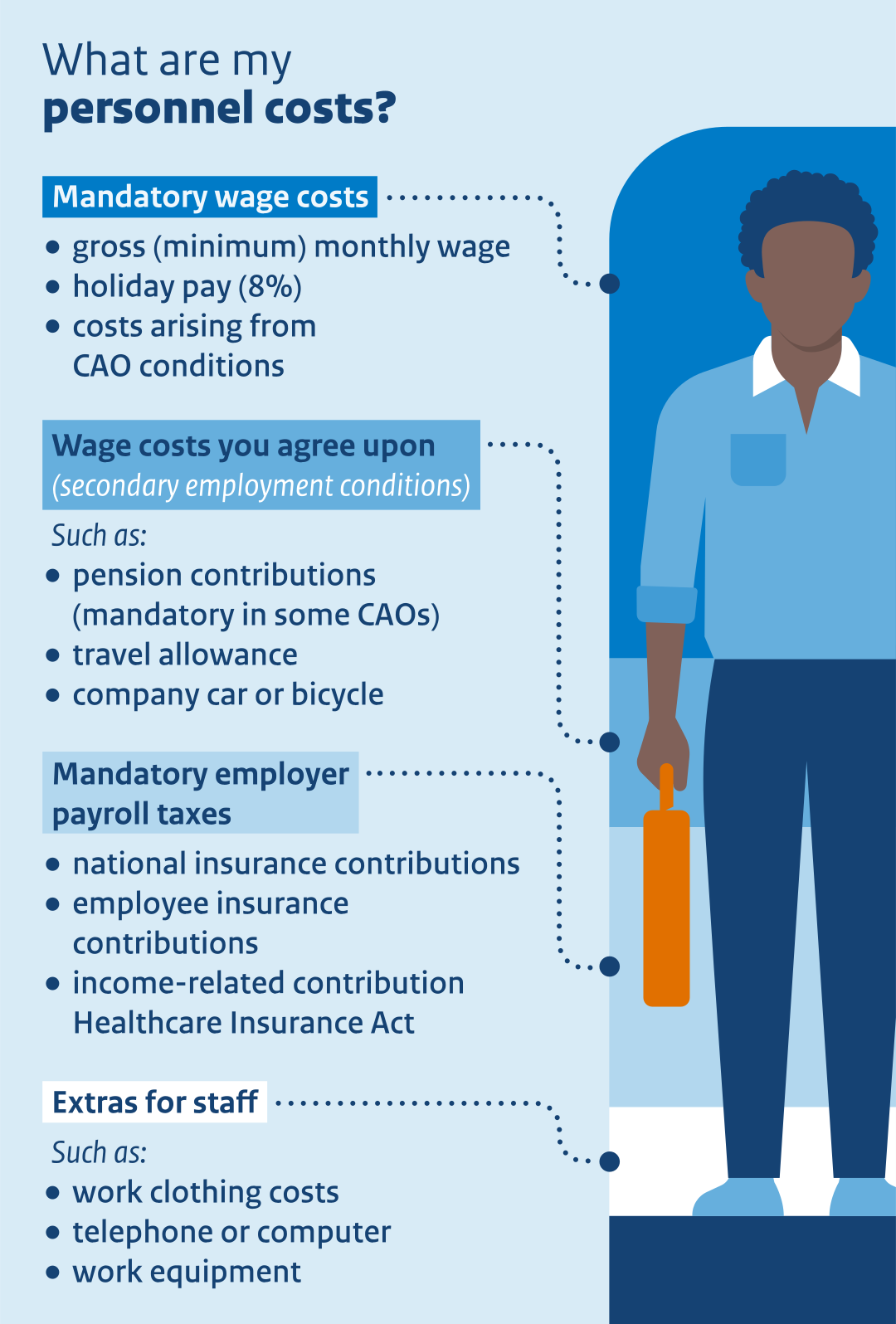
What are my personnel costs?
The infographic shows four categories of personnel costs.
- Mandatory wage costs:
- the gross (minimum) monthly wage
- holiday pay of 8%
- costs arising from collective labour agreements (CAO)
- Wage costs that you agree upon (secondary employment conditions), for example:
- a company car or bicycle
- travel allowance
- pension contributions (sometimes mandatory under the CAO)
- Mandatory payroll taxes for the employer:
- national insurance contributions
- employee insurance contributions
- income-related contribution under the Healthcare Insurance Act
- Extra personnel costs, for example:
- the costs of work clothing
- telephone or computer
- work equipment
If you are going to take on an employee for the first time, you must register as an employer with the Netherlands Tax Administration and with the Netherlands Chamber of Commerce KVK:
Register as an employer with the Tax Administration:
Fill in the form.
You will receive a payroll tax number (loonheffingennummer) and a payroll taxes return form (aangiftebrief loonheffingen).
You need these to deduct payroll tax from your employee’s salary and file a return.
Use the change Form 14 to inform the Netherlands Chamber of Commerce KVK that you are employing staff. You must always notify KVK of any changes to the number of people working for you.
Hiring staff as a sole trader
As a sole trader, a business owner of an eenmanszaak, you can employ staff. You do not have to change your legal structure.
- Keep a legible copy of the current identity document in your payroll records for any audits, for instance by the Netherlands Labour Authority.
- The copy must include all the details as shown on the original. If you copy a passport or identity card, make sure the citizen service number (Burgerservicenummer, BSN) is clear.
Download the Handboek loonheffingen (Handbook on Payroll Taxes, pdf, in Dutch) and read chapter 3 about setting up a payroll system (loonadministratie).
Personnel and privacy
When you hire staff for the first time, you will have to deal with EU privacy rules, the GDPR. Read how to comply with the GDPR. It applies to the following:
- recruitment and selection
- screening
- hiring
- personnel file
- disclosure of information
- monitoring of staff
Personnel screening
You want to choose reliable staff. With employee screening, you can limit the risks. You must comply with the privacy rules of the GDPR when screening.
Agree on terms of employment, such as salary, working hours, and holidays. Conditions of employment are often already established in a collective labour agremeent (CAO) for your sector. You may make additional arrangements. These must not conflict with the law or the CAO. Secondary terms of employment, such as a learning and development budget, or flexible working hours offer advantages. For example, a higher commitment of your employee.
The most common employment conditions are:
You must provide your employee with clear information on the most important labour conditions. This information should make the labour more transparent and predictable in advance.
You cannot view this video due to your cookie settings. Would you like to watch?or Watch this video on YouTubeHow cookies are used on Business.gov.nl.Draw up an employment contract
Verbal agreements on terms of employment are valid, but it is better to put your agreements in writing. You do this in an employment contract. The employment contract sets out the rights and obligations of the employee and the employer. You must provide certain details in writing (in Dutch) within 1 week and within 1 month of your employee starting work, such as their salary and working hours.
Read more about the different employment contracts on KVK.nl.
Agreements on non-compete and trial period
A non-compete clause protects your business if your employee leaves. You can agree a trial period with your new employee for up to 2 months.
Working without a contract
Does your employee work for you without a contract? Then the agreements you set out during an interview (verbal employment contract) apply. But by law, you must put some things on paper within 1 month after your employee has started. Some agreements are only valid if they are in writing.
You must pay your employee at least the statutory minimum wage or the youth minimum wage. The minimum wage applies to employees aged 21 and over. The youth minimum wage applies to employees between the ages of 15 and 21. Minimum wages are revised every 6 months, on 1 January and 1 July.
Your staff are entitled to a healthy and safe workplace. This is stated in the Working Conditions Act (Working Conditions Act, or Arbowet). The Working Conditions Act also applies when (your employees are) working from home. More relaxed working conditions rules apply to working from home.
As an employer, you must be supported by an occupational health and safety expert. For example, a company doctor or occupational health and safety service (arbodienst).
Make sure you put all the administration required into your payroll records before your employee starts working for you. This should include:
- data for payroll taxes and social security
- a copy of the employee’s identity document
- payslips
When you hire staff for the first time, you will have to deal with EU privacy rules, the GDPR. Take extra measures to protect your staff's personal data.
Paying the salary
There are rules for the payment of salary. And what you may or may not include in the salary. With the payslip, you inform your employee on how the salary is structured.
You must deduct payroll taxes from the salary. You must pay these payroll taxes to the Netherlands Tax Administration. On the website of the Tax Administration you can download:
If you design your own payslip, it must show the same data as the model.
Some sectors have a pension fund (bedrijfstakpensioenfonds). If that is the case, you are obliged to offer your employee a pension scheme. This also applies to certain professions. If no sector pension fund exists, you can choose to offer your employees a pension scheme. Consult an independent adviser (scroll down to Check de onderneming waarmee u zaken wilt doen and search for pensioenadviseur).
You cannot view this video due to your cookie settings. Would you like to watch?or Watch this video on YouTubeHow cookies are used on Business.gov.nl.If you hire staff, you may have to comply with more conditions within your company:
- As a business owner with employees, you must appoint at least one health and safety officer (preventiemedewerker). A health and safety officer deals with day-to-day health and safety within a business. Do you have 25 or fewer employees? Then as a director, you may be the health and safety officer yourself.
- You must ensure a safe (working) environment for your staff and visitors. An in-house emergency response worker (bedrijfshulpverlener, bhv’er) helps you do this.
- You are obliged to ensure that your employees can work safely and healthily. To this end, you must carry out a risk inventory and evaluation (RI&E).
Staff adviser: everything you need to arrange at a glance
Are you hiring staff for the first time? Or do you spend a lot of time on personnel matters? The Staff adviser on KVK.nl/en provides advice in your situation. For example, what you need to arrange when hiring staff. Or what to think about when your business grows.