Numbers for VAT

You have 2 numbers for VAT: the VAT identification number and the VAT tax number. You receive these numbers from the Netherlands Tax Administration after you register your company with the Netherlands Chamber of Commerce KVK. Read what you use these numbers for.
Do you want to view your VAT numbers? Log in and look under 'btw'.
Log in to Mijn Belastingdienst Zakelijk
VAT ID for business contacts
You use the VAT identification number (VAT ID) for all your contacts with customers and suppliers. For example, you put the VAT ID on your stationery, invoices, and website. You also use it if you do business within the European Union (EU).
A VAT ID has a fixed structure:
- Sole proprietors (self-employed professionals, freelancers, zzp’ers) : the country code NL + 9 digits + the letter ‘B’ + 2 digits. Your citizen service number (BSN) is not included in this.
- Other legal forms such as a VOF, CV, partnership, or BV: the country code NL + the Legal Entities and Partnerships Identification Number (RSIN) + the letter ‘B’ + 2 digits.
An example of a VAT ID: NL123456789B01.
VAT tax number: for contact with the Tax Administration
You only use the VAT tax number (omzetbelastingnummer, ob-nummer) for contact with the Tax Administration. For example, if you write a letter to the Tax Administration. Or if you call the Tax Information Line.
A VAT tax number has a fixed structure:
- For sole proprietorships, the VAT tax number is your citizen service number (BSN) followed by the letter 'B' and 2 digits.
- The VAT tax number for other legal structures is the RSIN number followed by the letter 'B' and 2 digits.
There is no NL in front of the VAT tax number as there is with the VAT ID.
An example of a VAT tax number is 111234567B01.
How do I get a VAT ID and a VAT tax number?
After you register with the Netherlands Chamber of Commerce KVK, the Tax Administration will automatically let you know within 10 working days if you are an entrepreneur for VAT purposes. If so, you will receive the VAT ID and VAT tax number. Even if you only have business activities that are exempt from VAT, such as foundations or associations.
Sometimes you cannot register with KVK. Find out how to register with the Tax Administration.
If you are not an entrepreneur for VAT purposes then you do not have a VAT ID or VAT tax number.
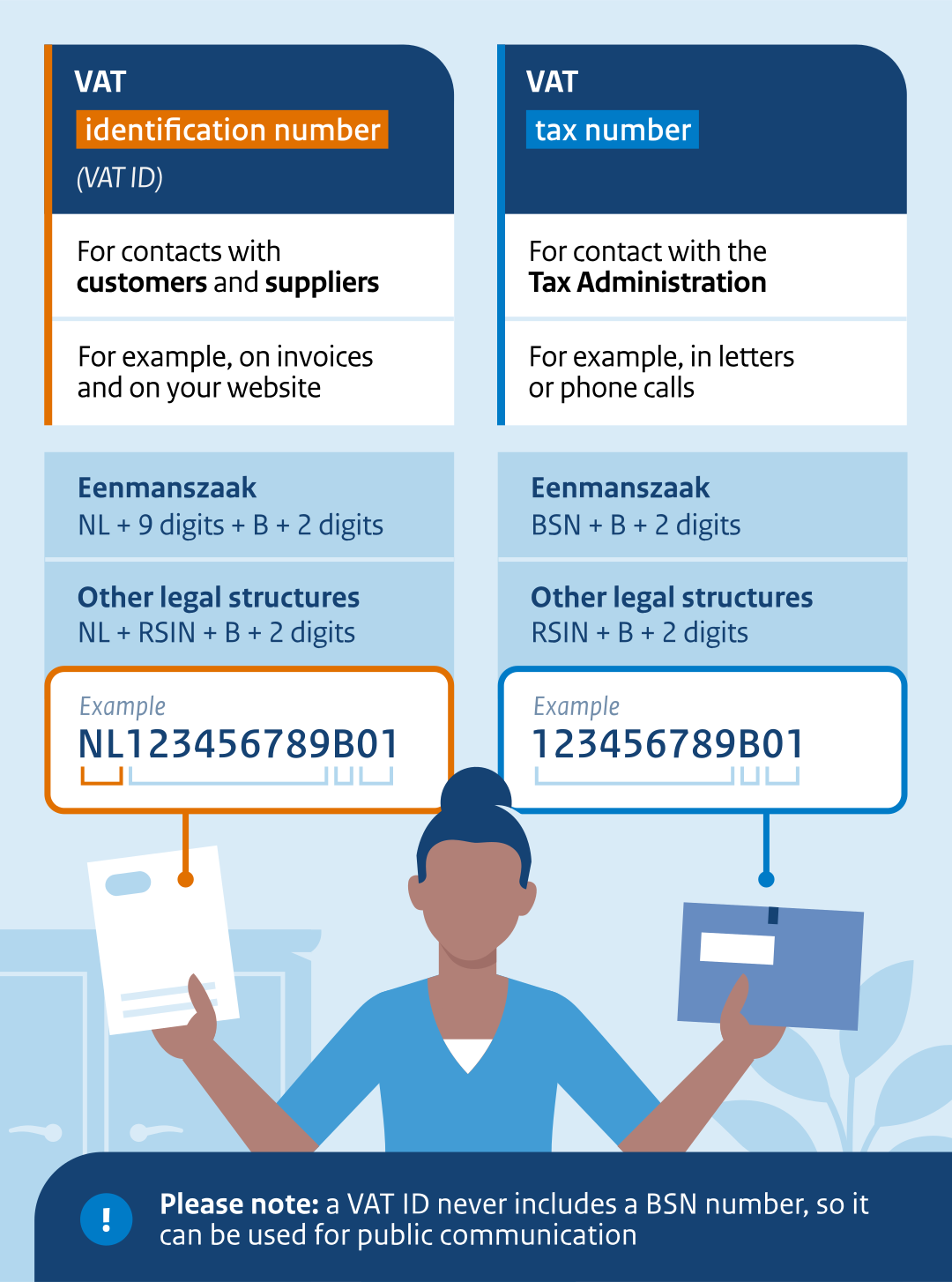
The main differences between the VAT identification number and the VAT tax number
The VAT identification number, also known as the VAT ID:
- For contact with customers and suppliers
- For example, on invoices and on your website
The VAT tax number:
- For contact with the Tax Administration
- For example, in letters or phone calls with them
The numbers are also structured differently:
- The VAT identification number for an eenmanszaak consists of NL + 9 digits + B + 2 digits. For other legal structures it is NL + Legal Entities and Partnerships Identification Number (RSIN) + B + 2 digits.
- The turnover tax number for an eenmanszaak consists of the citizen service number (BSN) + B + 2 digits. For other legal structures it is the Legal Entities and Partnerships Identification Number (RSIN) + B + 2 digits.
Please note: a VAT ID never includes a BSN number, so it can be used for public communication.
Request an extra VAT ID for new business activities
You can apply for an exra VAT ID from the Tax Administration. For example, because you are starting new activities with a different SBI code within your business. Or because you have several branches. This is not mandatory. If you do, you will also receive a second VAT tax number. You must file an additional VAT return and keep separate records for your second VAT ID.
Doing business within the EU
If you buy or provide products or services within the EU, you use your VAT ID. The system for the exchange of VAT information (VIES) only recognises that number. You also use your VAT ID for your VAT returns via the one-stop shop.
The Tax Administration also passes on your VAT ID to the tax authorities of other EU countries. For example, if they handle your request for a refund.
EORI number
If you trade internationally and come into contact with customs, you need an EORI number. Your VAT ID is automatically linked to your EORI number.