Professional partnership (maatschap)


In a professional partnership, a maatschap, you practise your profession alongside your partners under a shared name. No starting capital is required. Each partner is privately liable for an equal part of possible debts.
On this page
- What is a maatschap?
- How to set up a professional partnership
- Register your UBOs
- Draw up a partnership contract
- Administration
- Taxes
- Liability
- Signing contracts on behalf of the maatschap
- Hiring personnel in a maatschap
- Social security and national insurance contributions
- Ending a maatschap
- Changing your legal structure to BV
- Professional partnership between life partners
- Statistics: professional partnerships
What is a maatschap?
A professional partnership (maatschap) is a business in which at least 2 people work together. Each participant is a co-owner. The co-owners are also called partners. Partners carry out professional activities, such as dentists, physiotherapists, or lawyers.
Each partner contributes something. This can be money, but also goods or labour. Starting capital is not required. A maatschap does not have a legal personality. This means partners are equally liable for possible debts of the company. For exaple, with 4 partners, each partner is responsible for 25 % of the debts.
Public or undisclosed partnership?
When setting up a maatschap, you can choose between a public (openbare) maatschap and an undisclosed (stille) maatschap: • In a public maatschap, it is clear to the outside world that you are working together under the same name. • In an undisclosed maatschap, this is different. You do not operate under a joint business name. With an undisclosed maatschap, you can, for example, purchase materials together or rent office premises.
Tool for choosing a Dutch legal structure
If you are not sure which legal structure to choose, use our Tool for choosing a Dutch legal structure. It will guide you through some of the main issues, such as liability, staff and taxes, and give you advice suited to your needs and wishes.
Differences between maatschap and VOF will dissappear
A maatschap is a partnership, just like the general partnership (VOF) and the limited partnership (CV). The difference between a professional partnership and a general partnership will disappear. It is not yet known when. Read more about the new partnership structure and rules.
How to set up a professional partnership
You register the maatschap with the KVK:
- Make an appointment at a KVK office to complete the registration.
The KVK will enter all the basic details, such as:
- The name of the maatschap
- The maatschap’s activities
- The names of the partners
When you set up a maatschap, all partners (called maten) must register in the KVK’s Business Register. You will pay a one-off registration fee. The KVK will record all the basic details of your business, such as its name, activities and the names of the partners.
Shield your visiting address
Is the visiting address of the professional partnership the same as your home address? In some cases, you can shiled your visiting address in the Business Register. For example, because you are threatened and want to keep your address secret. To do so you must register a postal address, for instance a P.O. Box.
Read more about shielding your visiting address.
Register your UBOs
When registering a maatschap, you must also to register your ultimate beneficial owners in the UBO register. A UBO is a person who owns the organisation or has decision-making authority over it. You must register the UBOs with KVK’s UBO register.
Who are the UBOs of your CV, maatschap, VOF, EESV, or rederij?
Draw up a partnership contract
It is not mandatory to draft a partnership agreement when setting up a maatschap, but it is smart to do so. In the contract, you set out agreements about your partnership. For example:
- Who the partners are and the equity they each bring into the company. For example, cash, labour, or equipment.
- How profits are shared. This is based on the equity brought into the maatschap unless otherwise specified. Partners are not allowed to agree that 1 partner (maat) receives all the profit.
- Who has authority to do what. For example, whether each partner is allowed to make decisions independently, or whether partners must sign jointly for expensive purchases.
- How and in which situation you end the partnership.
You can draw up a partnership contract (maatschapscontract) yourself. Or you can arrange it through a lawyer or civil-law notary. The purpose of the partnership and the powers of the partners are recorded by KVK in the Business Register.
The costs for drawing up a partnership agreement differ depending on the civil-law notary or lawyer.
Read more about drawing up a partnership contract.
Administration
You are legally obliged to keep records. You can outsource this to a bookkeeper or accountant.
Taxes
Each partner pays income tax on their part of the company’s profit. If the Netherlands Tax Administration regard you as an entrepreneur for income tax, you are entitled to an SME profit exemption (mkb-winstvrijstelling). If you also meet the hours criterion, you are entitled to more tax benefits, such as the private business ownership allowance (zelfstandigenaftrek). Starters may also be eligible for tax relief for new companies (startersaftrek).
The professional partnership also pays VAT.
Read more about tax benefits and deductions.
Make a division of profit
There are 2 ways to divide the profit:
- You divide the profit as laid down by law. Each partner receives profit in proportion to the equity they bring into the company.
- You make agreements with each other about the division of profit, for example in a partnership contract. It is not possible for 1 partner to receive all the profits. You can agree that 1 partner is responsible for all losses.
Liability
A professional partnership is not a legal personality. This means that the partners are responsible for their own actions. And also personally liable for the partnership's debts. But, unlike other partnership structures, you only enter into commitments on your own behalf, and not on behalf of the other partners. If you purchase equipment, enter into contracts with customers, or hire someone, you alone are responsible for the debts. In turn, creditors of other partners cannot come to you to claim payment (outstanding bills).
Creditors will first make a claim on your business assets. If you have insufficient assets to pay off your debts, creditors will claim our private assets. All your assets can be seized to pay your debts, including your savings and your home if you own it.
Partner liability
Do you have a life partner? If so, your partner may also have to contribute to paying off your debts. Whether your partner is also liable depends on the official status of your relationship and when it began. With prenuptial or partnership agreements, you can prevent creditors from accessing your partner's money. The rules for a marriage and registered partnership are the same.
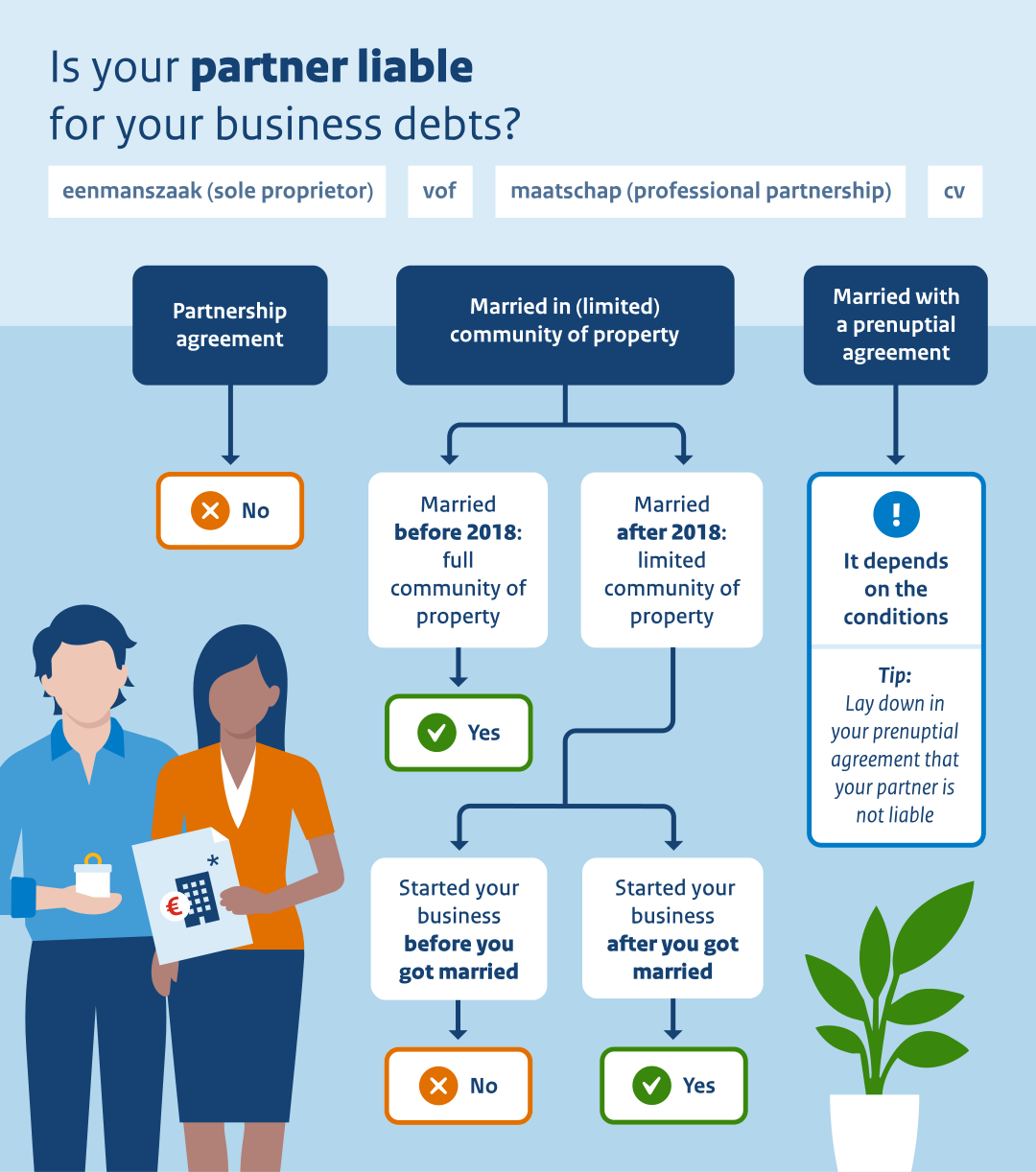
Flowchart: Is your partner liable for the debts of your business?
This flowchart applies to the legal structures of sole proprietorship, VOF, professional partnership and CV.
- What is the legal status of your relationship with your partner?
- Partnership agreement: your partner is not liable. [end]
- Married with a prenuptial agreement: it depends on the conditions. Tip: agree in your prenuptial agreement that your partner is not liable. [end]
- Married in community or limited community of property. Go to question 2.
- When were you married?
- Before 2018. You are then married in full community of property: your partner is liable. [end]
- After 2018. You are then married in limited community of property. Go to question 3.
- When did you start your own business?
- You started your own business before you got married: your partner is not liable. [end]
- You started your own business after you got married: your partner is liable. [end]
Read more about your partner's liability for your business.
Opening a business bank account as a maatschap
It is not compulsory to open a business bank account as a maatschap. But it may be advisable. For example, you can agree that several people must give their approval for large payments. Also, many banks prohibit the use of a personal account for business purposes.
Are you liable for what your partners do?
If a partner acts against the law or breaks any agreements, then the other partners are usually not liable. Only in the following situations are all partners equally liable:
- The partners have given each other power of attorney as specified in a partnership contract.
- The partners decide to act jointly or make a joint purchase, for example, hiring a receptionist or renting a practice.
Example: You have a professional partnership with 3 other people. Together you have hired a receptionist. You are then each liable for a quarter (equal share) of any debts arising from this.
Signing contracts on behalf of the maatschap
In a professional partnership you only make agreements for yourself. You cannot sign contracts or perform legal acts, such as reporting a change in the Business Register.
Do you want some partners to have more authority than others? Then you can make agreements in the form of power of attorney (volmacht) and lay this down in a partnership contract. You must report this change to KVK.
What is power of attorney
The maatschap can also assign power of attorney to someone else. This person (gevolgmachtigde) may then act on behalf of the professional partnership.
You can register this person in the Business Register. This is not mandatory, but usefull. This way business relations of the maatschap know who is allowed to act on behalf of the company.
Hiring personnel in a maatschap
A professional partnership may hire staff. You must pay payroll taxes and social contributions for your personnel. If you are hiring an employee for the first time, you must register as an employer with the Tax Administration. You must also report this to KVK.
Read the checklist Employing staff in the Netherlands for more information.
Social security and national insurance contributions
What you are insured for
As a self-employed partner, you pay national insurance contributions towards the national insurance schemes. These schemes include the:
- General Old Age Pensions Act (AOW)
- General Surviving Relatives Act (Anw)
- Long-Term Care Act (Wlz).
You will receive AOW from the day you reach the AOW retirement age. The AOW is a minimum income. You can arrange a supplementary pension yourself.
If you are pregnant, you are entitled to a maternity allowance (ZEZ) of at least 16 weeks. You can apply at the Employee Insurance Agency (UWV). Read about the terms and conditions for maternity benefit.
What you are not insured for
You are not entitled to benefits under the Sickness Benefits Act (ziektewet), the Unemployment Benefits Act (WW), or the Work and Income (Capacity for Work) Act (WIA). You should take out your own disability insurance (AOV).
Depending on your type of business, it can be wise to take out additional insurance.
Ending a maatschap
If a partner withdraws
If a partner withdraws or dies, the maatschap is dissolved and closes down. Do you want the maatschap to continue after a partner has left? You can arrange this in the maatschap agreement by including a survival clause (verblijvensbeding) or a buy-out clause (overnamebeding). This means that the remaining partner or partners will take over the share of the partner who has left or died. In the agreement, you set out who is entitled to what and how you will divide the business.
The maatschap can then continue in various ways:
- as a maatschap with a new partner.
- as an eenmanszaak
If the maatschap continues with a new partner, you must update the details with KVK:
- the new partner must register
In addition, you must also amend the partnership agreement.
When the maatschap closes down
If the partnership stops altogether, you must dissolve (ontbinden) the company. To do this, all the partners must give notice. After this, the partners must divide and liquidate the assets. This means that the partners pay the debts and possibly get their share back in cash or in kind, such as products.
The way this is done is set out in the partnership contract. For example, you can agree that you divide what remains based on each partner's share of the profits. Or that if there are any remaining debts, you pay the debts from your private assets.
Make sure you report the changes to KVK and the Tax Administration.
Read the step-by-step plan for ending your maatschap.
Consequences of deregistration
Deregistering your business or a board member may affect your bank account, financing, insurance, pension fund, or municipal permits. For example, if you are deregistered from KVK, you can no longer access your business bank account. So, check what assets are registered in the maatschap’s name (such as bank accounts and vehicle registration numbers) and sort these out before you deregister the maatschap with KVK.
Changing your legal structure to BV
You can change the partnership into a private limited company (BV). One of the differences is that the BV is liable for finances and possible debts. There are several ways to change a maatschap into a BV. These steps are similar to changing a sole proprietorship into a BV. You must divide the shares in the BV in the same way as the assets were divided in the partnership.
Note: Be aware that for tax purposes, the Tax Administration views changes in legal structure as ending one business and starting another.
Professional partnership between life partners
A maatschap is also a suitable legal form for spouses or registered partners to work together. If the Tax Administration considers both partners to be self-employed, this provides double tax benefits. You are both entitled to various exemptions and deductions. However, the division of profits must reflect how the work is done. For example, you may not share profits 50/50 if one partner does 90% of the work.