Sole trader or sole proprietorship


What is an eenmanszaak? It is a Dutch legal structure, and it means sole trader or sole proprietor. Read this article to find out how to start an eenmanszaak in the Netherlands.
On this page
- What is a sole proprietorship?
- Setting up and registering a Dutch sole proprietorship
- Administration
- Income tax and VAT
- Liability
- Signing authority
- Sole proprietor and employees
- Dutch social security and national insurance contributions
- Changing your legal structure
- Ending your sole proprietorship
- Sole proprietorship or BV, what suits you?
- Statistics: sole proprietorships
Many starting entrepreneurs choose sole proprietor (also called sole trader), or eenmanszaak as their legal structure. Setting up as a sole proprietor is quick and easy.
What is a sole proprietorship?
An eenmanszaak is a legal structure without legal personality. As sole trader you alone are responsible, and personally liable, for the business, its finances, and its debts. You can only set up 1 sole proprietorship in the Netherlands, but you can operate under various trade names, perform different business activities, and work from more than 1 establishment.
Difference from freelancer and zzp'er
Freelancer and zzp'er (zelfstandige zonder personeel) are not legal structures in the Netherlands. Most freelancers and zzp'ers who register at KVK, do so as a sole proprietor.
Tool for choosing a Dutch legal structure
If you are not sure which legal structure to choose, use our Tool for choosing a Dutch legal structure. It will give you advice suited to your needs and wishes.
Setting up and registering a Dutch sole proprietorship
To set up as a sole trader in the Netherlands, you have to register with the Netherlands Chamber of Commerce KVK. KVK will pass on your details to the Netherlands Tax Administration (Belastingdienst). They will determine if you are an entrepreneur for VAT (BTW). If you are, they will send you your VAT-identification number and VAT tax number by post within 2 weeks.
Registering at KVK online
You can register your eenmanszaak online. You need your DigiD to do so. To finalise your registration, you need to make an appointment at one of the KVK offices. You pay a one-time registration fee (inschrijfvergoeding). Once registered, you can access My KVK using your DigiD or European eID to look up your company extract. You can then check that all the details are still correct and report any changes directly.
Shield your visiting address
As a sole proprietor, you can hide your visiting address in the Business Register. For example, because you want to keep your address secret because of your profession. To do so you must register a postal address that is different from your home and visiting address, for instance a P.O. Box. Have you not yet started your business? If so, when registering, state that only your postal address may be visible. This must be a different address to your home address.
Read more about shielding your visiting address.
Administration
You must keep records for your business. Your records must meet a number of requirements. You must keep your records for at least 7 years.
Bookkeeping
An important part of your records is bookkeeping. This is an overview of all your financial matters. This includes your income and expenses, VAT paid and received, inventory, and cash in the bank. It also includes invoices and quotes. You use your bookkeeping to prepare your annual financial statements.
The financial statements (jaarrekening) provide an overview of your profit or loss and are used for your tax returns. You are not required to file your financial statements with KVK.
You can outsource your administration to a bookkeeper or an accountant. Prices for this are on average between €500 and €1,000 a year.
Income tax and VAT
You must pay income tax (inkomstenbelasting) on your sole proprietorship's profits. Various rates apply in the Netherlands according to how the Tax Administration categorises income.
There are three tax brackets, that are referred to in the Netherlands as boxes – Box 1, Box 2 and Box 3. Profits from your sole proprietorship are taxed under 'Box 1 – Taxable income from employment and home-ownership' (belastbaar inkomen uit werk en woning).
If the Tax Administration recognises you as a business owner, and you meet the hours criterion (you have to put a minimum of 1,225 hours per year into your company to qualify), then you'll be entitled to certain entrepreneurs' allowances (ondernemersaftrek): several tax benefits, such as private business ownership allowance (zelfstandigenaftrek) and tax relief for new companies (startersaftrek).
After having deducted these allowances from their profit, entrepreneurs are entitled to extra tax relief, through the SME profit exemption (mkb-winstvrijstelling).
See additional information about paying taxes in the Netherlands
VAT (turnover tax)
If the Tax Administration considers you an entrepreneur for VAT, you will have to pay VAT on your turnover. Whether you are considered a VAT entrepreneur depends on your situation (in Dutch).
Small businesses scheme
Is your turnover less than €20,000 a year? Then you can apply for the small businesses scheme (KOR). If you use the KOR, you don’t charge VAT.
Liability
In the Netherlands, a sole proprietorship is not a legal entity. This means you are liable for all your business's actions and you are personally liable for any debts with your own money. If your business does not have enough funds to pay your bills, you must use your personal funds to cover them. All your assets count toward paying off your debts, including your savings and your home.
Debts and your partner
Do you have a partner? If so, your partner may also have to contribute to your debts. Whether your partner is also liable depends on the official status of your relationship and when you entered into it. With prenuptial or civil partnership agreements, you can prevent creditors from accessing your partner's money. The rules for a marriage and registered partnership are the same.
> Read more about your partner's liability
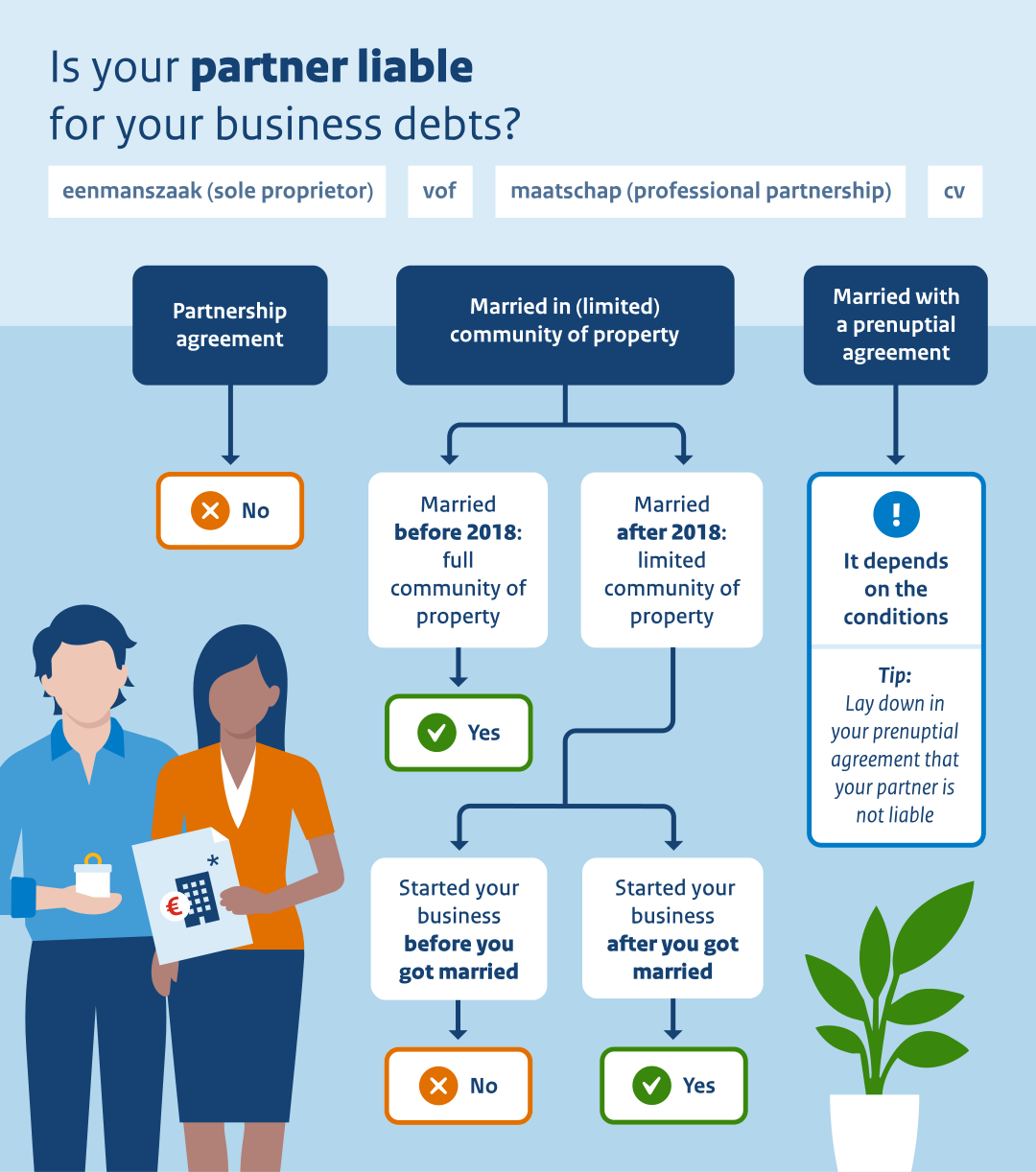
Flowchart: Is your partner liable for the debts of your business?
This flowchart applies to the legal structures of sole proprietorship, VOF, professional partnership and CV.
- What is the legal status of your relationship with your partner?
- Partnership agreement: your partner is not liable. [end]
- Married with a prenuptial agreement: it depends on the conditions. Tip: agree in your prenuptial agreement that your partner is not liable. [end]
- Married in community or limited community of property. Go to question 2.
- When were you married?
- Before 2018. You are then married in full community of property: your partner is liable. [end]
- After 2018. You are then married in limited community of property. Go to question 3.
- When did you start your own business?
- You started your own business before you got married: your partner is not liable. [end]
- You started your own business after you got married: your partner is liable. [end]
Signing authority
The owner of the business always has full authority to sign. This means you are entitled to sign contracts in the name of your business or perform certain legal actions, such as reporting a change in the Business Register.
Grant authorisation
You can give someone a power of attorney (authorisation). This is a declaration that this person is allowed to act on behalf of your company.
Tip: if you give someone power of attorney, register them in the Business Register as well. This is not mandatory but it is useful. It means your business partners can verify who has authority to act on behalf of the company.
Sole proprietor and employees
Despite the name, sole traders can employ staff. The Dutch term 'eenmanszaak' (literally 'one-man business') simply refers to the legal structure and has nothing to do with the number of people employed by your business. There is no limit on the number of people you may employ.
Employees and taxes
You are required to pay payroll taxes and social security contributions for your employees. The first time you hire an employee, you must register as an employer with the Tax Administration and notify KVK.
> Read what hiring staff involves.
Dutch social security and national insurance contributions
Pension
As a sole proprietor in the Netherlands, you must to pay national insurance contributions (volksverzekeringen) and you will be entitled to an state pension (AOW) once you reach the state pension age. This pension is a minimum income, which you can supplement yourself.
Disability and illness benefits
You are not entitled to disability, illness or unemployment benefits. If you want to be certain of an income, even if you fall ill or have insufficient work, you can take out disability insurance.
Maternity benefits
If you are pregnant, you are entitled to maternity pay for 16 weeks or more. You can apply for this at the Employment Insurance Agency UWV, read about the terms and conditions.
Depending on your type of business, you may want to take out other kinds of insurance.
Changing your legal structure
You can change your legal structure from sole proprietor to private limited company (BV). One of the advantages is that not you, but the BV will be liable for the company, including its finances and debts. There are several ways in which you can convert your sole proprietorship into a BV.
You can also decide to join a general partnership (VOF) or, if you practice a regulated profession (like dentist, architect, or surgeon), a professional partnership (maatschap). Joining a partnership means you can collaborate and share costs.
Read more about changing your legal structure
Ending your sole proprietorship
Should you decide to end your business, you must deregister at KVK. You must also settle with the Tax Administration. If your company has increased in value over time, you will have to pay a discontinuation profit tax. Have you built up a fiscal retirement reserve? This also counts as income, and you will have to pay tax.
Read more about ending your business.
Consequences of deregistration
Deregistering your business may affect your bank account, financing, insurance, pension fund, or municipal permits. For example, if you are deregistered from KVK, you can no longer access your business bank account. So before you deregister from KVK, consider what you need and what it could mean for you.
Sole proprietorship or BV, what suits you?
Many starting entrepreneurs are unsure whether to start up as an eenmanszaak or a BV. Read more about making the choice between a sole proprietorship or a private limited company.