Checklist: Rules for dropshipping products


With dropshipping, you sell products online without having to send them yourself. The supplier takes care of that. However, you remain responsible and liable for the products you sell. Read here to find out what you will need to deal with if you are thinking of getting started with dropshipping.
What is dropshipping?
With dropshipping, you set up an online shop without holding any stock:
- Your customer buys the product from you.
- You order the product from the supplier.
- The supplier sends the product directly to your customer.
You can sell the products via your own online shop or via an online sales platform.
Pro's and cons of dropshipping
Dropshipping has both advantages and disadvantages. For example:
- You do not need to buy and store stock.
- You do not need staff for packing and shipping.
- You are responsible for the buyer receiving the product.
- You are liable for damage caused by unsafe products.
Read more about the pros and cons of dropshipping on kvk.nl.
Before buying anything, your customer needs to know:
- that another party will deliver the product directly to the customer
- from which country the product will be shipped
- what the delivery time is for the product
Make sure your customer does not have to search for this information. For example, display this mandatory information above the ‘Order’ button on your product page.
You must comply with the rules governing online sales. For example:
- Be clear about your company, products and prices.
- Clearly display your contact details on your website. You must provide an email address and a telephone number. A contact form alone is not sufficient.
- State what rights your customer has for the payment, delivery, service, and a cooling-off period.
- Keep good records of which products you sell to which customers. By law, your products must be findable if something is wrong.
Is your online shop based in the Netherlands? If so, your customers must be able to return their purchases to an address in the Netherlands. This address must be easy to find. You should also make it clear who pays the return costs and how much they are.
Your customer has a cooling-off period and the right of return
By law, a consumer has at least a 14-day cooling-off period. Within this period, they may return products. Since 25 June 2026, your website must have a cancellation button. That allows customers to easily cancel their purchase during the cooling-off period.
The products you sell must be safe. There are rules for this.
If your product does not meet the safety requirements, you are at risk. For example, you will have to pay compensation for any damage caused by your product.
Your responsibilities depend on your role and the type of product you sell. Complete the online tool to determine your role in the supply chain. You will then see which rules apply to you.
In addition, there are requirements for product packaging and labelling of the products you sell.
Lower your risks in the event of damage
With business liability insurance, you are covered if your product causes damage.
It is forbidden to import counterfeit goods. You should therefore check carefully that the products you sell are not counterfeit and do not infringe any protected trade marks. Customs Administration of the Netherlands checks whether products may be counterfeit. If you sell such products, you are liable for this.
Ask for permission to import trade-marked products
Are you going to sell trade-marked products originating from outside the European Economic Area (EEA)? This includes all countries in the European Union plus Liechtenstein, Norway and Iceland. You may only place protected trade-marked products from outside the EEA on the market within the EEA with the permission of the trade mark owner.
VAT rules can be complicated with dropshipping. How and where you must pay VAT partly depends, for example, on:
- if you are selling to a private consumer or another business
- if you are trading within or outside the European Union (EU)
Are you supplying abroad? Then, in many cases, you need to register the VAT in the customer's country. Several options are available for international dropshipping.
Do you import goods from suppliers outside the EU? You will usually have to pay import duties on products from outside the EU.
Read more about paying import duties.
Do I have to pay import duties?
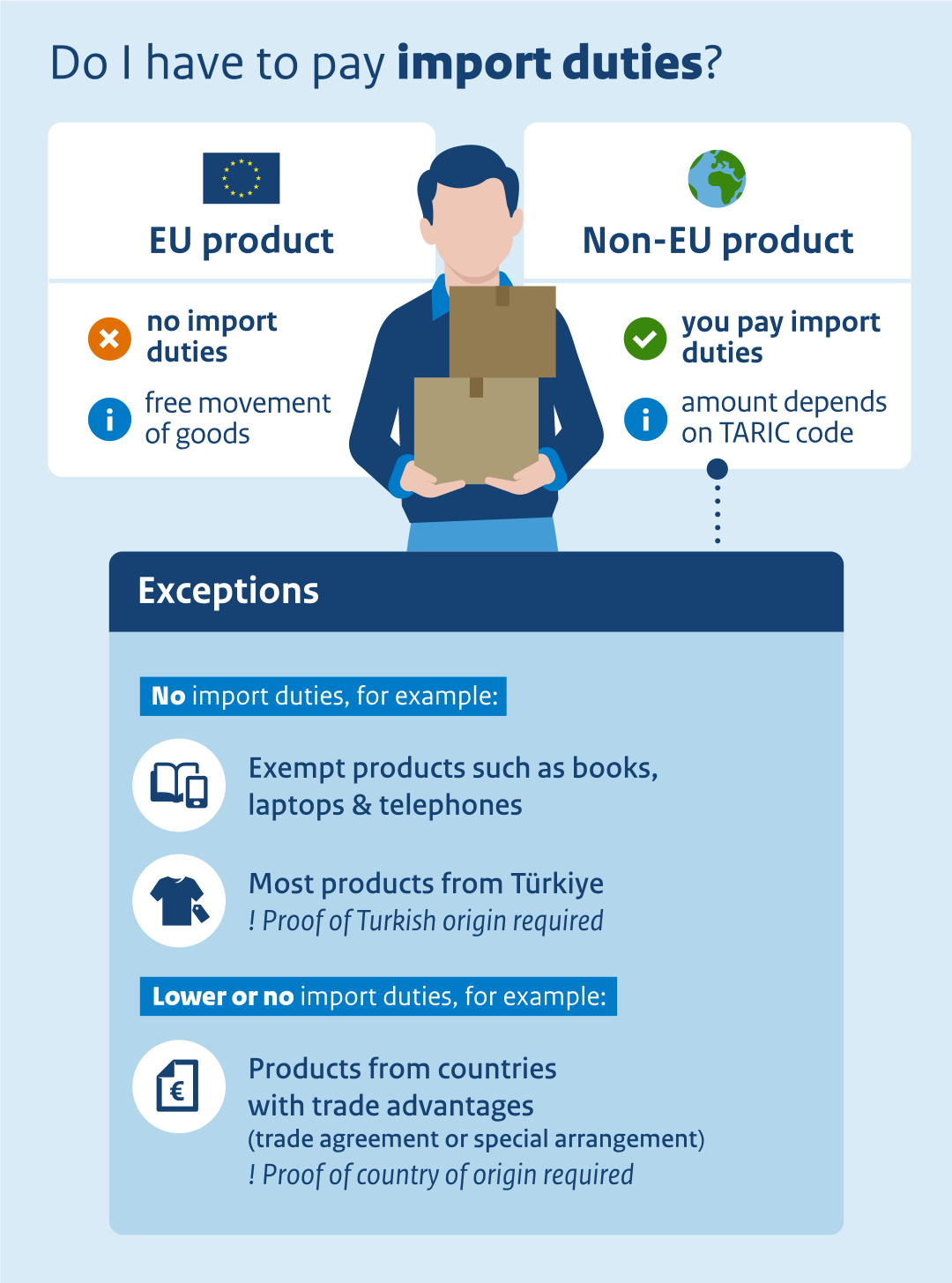
Does the product come from the EU? Then you do not pay import duties. There is free movement of goods in the EU.
Does the product come from outside the EU? Then the main rule is that you do pay import duties. The amount depends on the product's TARIC code.
However, there are exceptions to this main rule. These are a few of the exceptions: You do not pay import duties for exempt products, such as books, laptops, and phones. Also, most products from Türkiye are exempt from import duties. You will then need proof of Turkish origin.
You also pay fewer or no import duties for products from countries with a trade advantage. A trade advantage may come from a trade agreement or a special arrangement. You will then need proof of country of origin.
Import duties on shipments up to €150
Do you deliver online orders from outside the EU directly to consumers within the EU? If so, you pay a flat-rate import duty of €3 per product type for e-commerce shipments with a value of up to €150. From 1 July 2028, the standard customs duty rate for the imported product will apply.
You will have to deal with your customers' personal data. For example, name, phone number, and address. In doing so, you must follow the rules of the General Data Protection Regulation (GDPR). For example:
- You may not ask for more data than necessary. For example, to send a package, you need the address but not a date of birth. So you may not ask for a date of birth, unless you are selling a product restricted to customers 18 years and older.
- If you collect personal data via your website, you should at least use a secure transfer protocol (https). This prevents criminals from reading along with the traffic to your website.
- Your online shop's default settings should support the privacy of your customers. For example, you should not pre-tick a field with ‘Yes, I want to receive news about offers’.
- You must let your customers know what you do with their personal data. You do this with a privacy statement on your website.
- You must not share your customers' personal data with others.
Many websites use input fields where website visitors can leave data. For example, to enter payment or contact details. These input fields can be used by criminals to steal data. This is called formjacking.
Prevent your customers’ details from being stolen. For example, by:
- offering a secure payment method such as iDEAL|Wero, so that your customers do not have to enter their credit card details
- having the security of your website tested
You are responsible for the fair production of your products
If you do business abroad, the Dutch government expects you to operate in a socially responsible manner. So make sure you know what happens in your production chain. For example, ask your supplier:
- Where the product comes from and how it is made
- What raw materials have been used
- How many hours the staff work and under what working conditions
Resources for fair products:
- you can get advice on responsible business conduct from the RVO CSR Support Centre (MVO steunpunt, in Dutch)
You may be responsible for the waste generated by your product
For example, if you sell electrical and electronic products such as mobile phones and laptops. Or textiles, such as clothing, towels, and bed linen. These products are subject to an extended producer responsibility (EPR) scheme. This means that you are responsible for the waste if you place these products on the market. This also applies if you sell them via dropshipping. You must then assist with collection and recycling. Check which products are subject to EPR and what you need to do
You will be responsible for your products not destructing forests
From 30 December 2026, you will not be allowed to market products that contribute to the disappearance or damage of forests. These include products made from raw materials such as wood, cocoa, palm oil, and soy.
For SMEs and sole traders, this will apply from 30 June 2027. Do you trade in wood? Or in products that contain wood? Then you must comply with the rules from 30 December 2026.
Check for which products and raw materials these rules apply to.